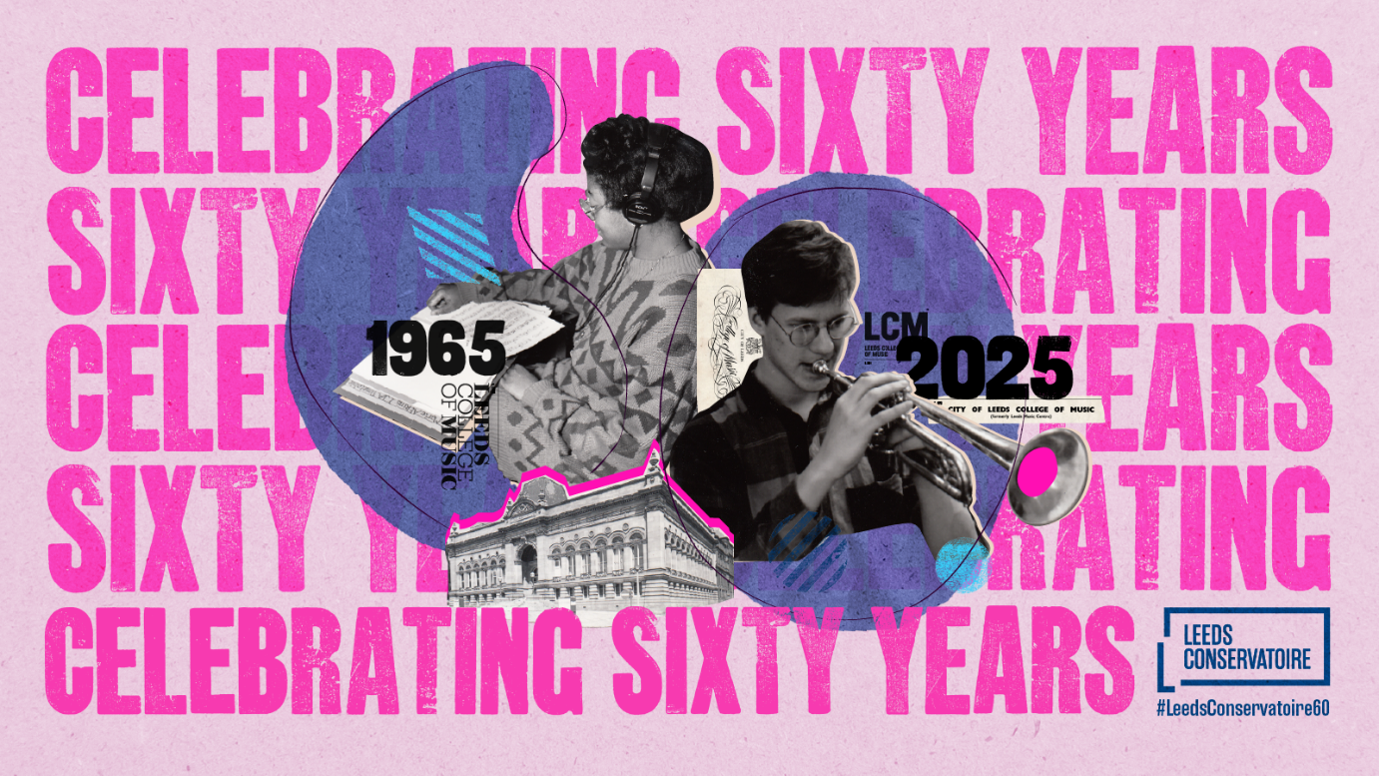
Today on the IAML (UK & Irl) blog: Laura Johnson, Assistant Librarian at Leeds Conservatoire, tells of her journey deep into the Conservatoire Archive, and the fascinating discoveries made along the way:
In September 2025, Leeds Conservatoire celebrated its 60th anniversary. This milestone, and the need to represent it in some sort of tangible way, kickstarted a process of archival exploration and investigation.
While we’ve always known (or at least had a vague idea of) what our Special Collections comprised, our institutional archive was more of a mystery to us. We approached it with two aims:
- To find out what we had and make sure that information was documented somewhere.
- To provide content for our 60th anniversary celebrations and the exhibition that was scheduled to take place at the heart of them (which is currently ongoing at Leeds City Museum, but only until the 28th of June!).
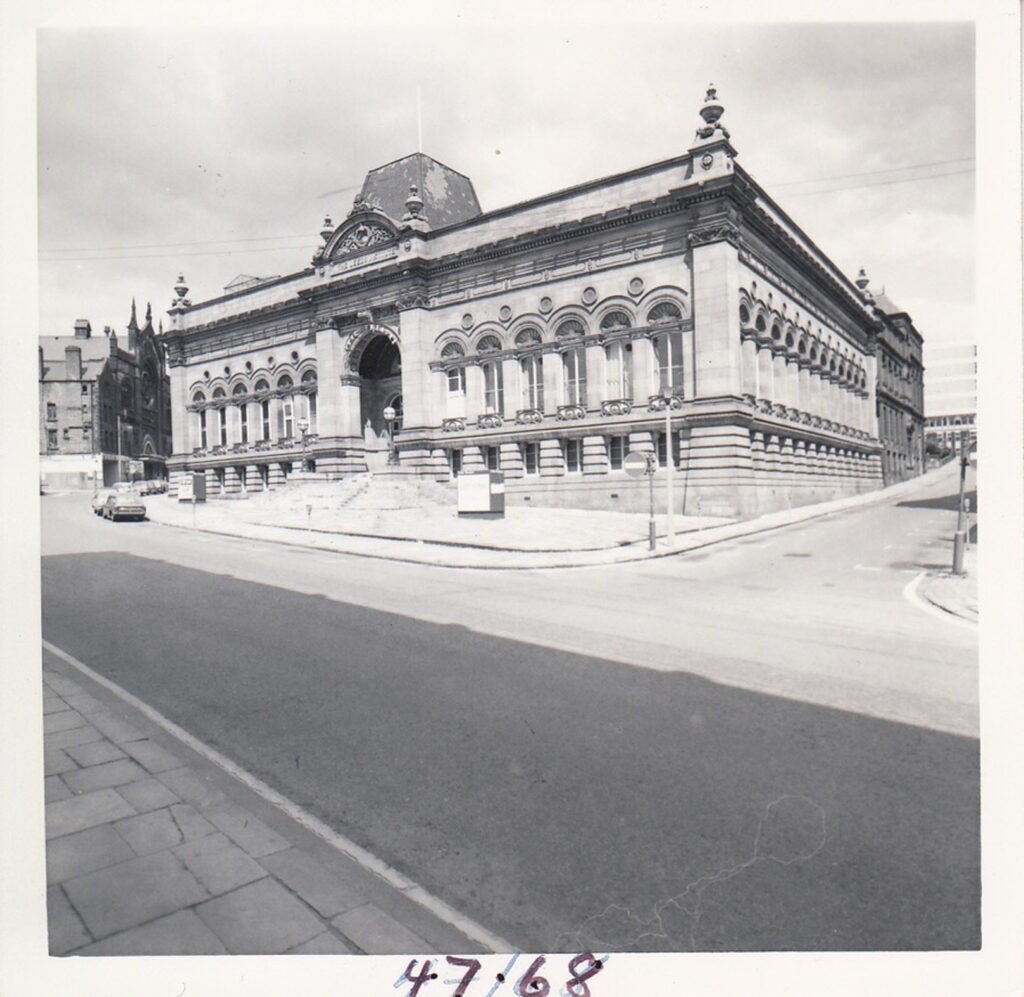
The conservatoire was founded in 1965 as Leeds Music Centre. We were originally housed in the Institute Building, which is now Leeds City Museum. We subsequently became City of Leeds College of Music in 1972, and then simply Leeds College of Music in 1998, when we moved to a new purpose-built site in Quarry Hill. Most recently, we became Leeds Conservatoire in 2020.
At the outset of this project, our institutional archive was spread across various sites. Within a locked rolling stack in the library were a multitude of items we were very vaguely aware of: posters, programmes, photographs, prospectuses… a plethora of Ps. Meanwhile, in a dark and dank room on a separate campus entirely was a large number of boxes, which we only discovered the existence of when we were asked if they could be destroyed! It was pure coincidence that the room they were being kept in needed to be emptied out at exactly the same time we were delving into our archive. These boxes held a slightly less exciting – but extremely important – part of our institutional archive: governance papers, meeting minutes, financial documents, and even the original college seal. Once we realised what they were, we rescued them and moved them to a temporary storage unit instead.
These boxes were only very, very recently relocated to the conservatoire itself, and they don’t play a particularly big part in this blog post. But for the foreseeable future, they will play a big part in my life, as I now spend a lot of my time going through them with the intention of: weeding any irrelevant items; applying the retention schedule developed by our consultant archivist; and cataloguing them in more detail.
But that’s now. In early 2024, we were focused entirely on items already in the library. The magnificent Heather Roberts, archivist and museum manager at the Royal Northern College of Music, came on board as our consultant archivist and created a spreadsheet template for us to use, which was very simple and consisted of the following fields: title, date, creator, department, description, and state.
My colleague Rebecca and I began digging through these boxes with the anxiety and trepidation of two librarians with no archival experience. While we were repeatedly told by everyone that there was no wrong way of going about this, we still managed to create completely different entries. Where Rebecca was very accurate in her description of the physical state of items (giving exact measurements, assessing any damage in detail), I was providing vague and unhelpful descriptions such as ‘small document’ when referring to anything that wasn’t A3 (which I considered ‘large’), and ‘good’ or ‘bad’ when referring to the physical state of an item (whatever that means!). On the other hand, I was going into excruciating detail when describing the content of the items: listing off participating staff/student/performer names, works performed, instrumentation, irrelevant details of the concerts, superfluous things I thought were interesting, etc., while Rebecca was being more concise in this regard.
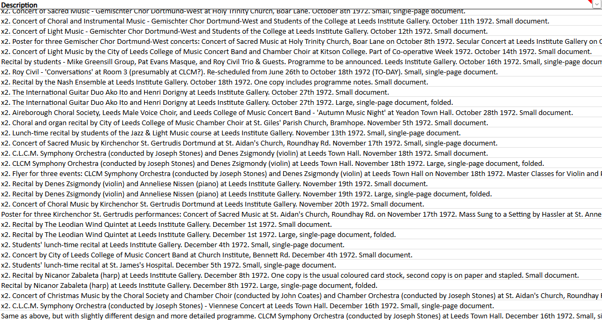
Not only was our data somewhat incongruous in this sense, it was also far more comprehensive than it ever needed to be. Archive catalogues don’t generally go into this level of detail, at least not when the number of items is somewhere in the thousands.
This Performance and Programming spreadsheet now contains over 4,000 items, and Heather is currently formulating a plan to import it into AToM, our archive catalogue software, in a way that doesn’t accidentally destroy all of the information we spent so long gathering. But for now, it exists in all its inconsistent, slightly nonsensical glory, and it has actually been extremely useful for exhibition curation purposes, in that you can simply search for a name or a place or a year and see if there are any results.
There was a second approach to exhibition curation that involved a series of giant scrapbooks, perhaps the most unique (and the most fragile!) items in our institutional archive. We believe the scrapbooks were started by a man called Ian Milnes, who worked as a ‘tutor-librarian’ for four years between 1969 and 1973. There are nine volumes of scrapbooks in total, continued up until the year 2000, but these initial four years are by far the most well-documented: there are programmes, newspaper cuttings, photographs, annotations, amendments, and ephemera, all carefully curated and laid out, occasionally hanging on by a thread (of crumbly old Sellotape).
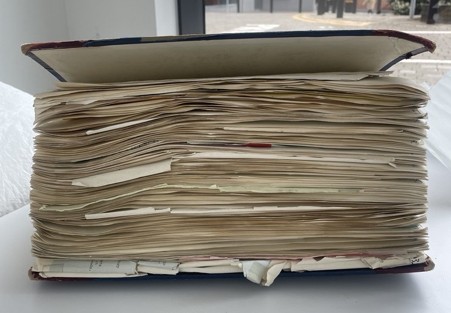
In early 2025, we wanted to find out what exactly was in these scrapbooks, and as quickly as possible, as our 60th anniversary celebrations were only a few months away. It was decided that a small group of people from various departments would spend one day a week going through a scrapbook and uploading anything of interest to a shared Padlet. This exercise had its pros and cons. Because we were working to a tight deadline and our main goal was exhibition curation, we didn’t necessarily create something particularly permanent or ‘professional’. While we do still have the Padlet, it’s full of shadowy reference photos we took on our phones with our hands getting in the way; we didn’t always remember to include scrapbook volume and page number references, so it can be difficult to locate things after the fact; we were all interested in different themes and criteria and there was very little coherence to our findings; and to this day we’re still coming across significant items that we missed in those initial searches.
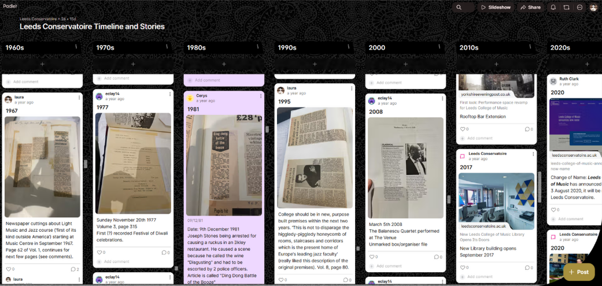
It was a lot of fun, however, and I’ve really come to appreciate several things about this exercise, especially after speaking with various IAML colleagues at the recent Annual Study Weekend (ASW) in Cardiff. We may not have come away with a nice tidy spreadsheet, but the project brought together academic and business support staff who otherwise do not necessarily interact all that often. Yes, we were all focusing on and emphasising different aspects, but this in itself is a good thing! I was particularly inspired by a paper presented by Judith Dray and Mandie Garrigan at this year’s ASW, in which they spoke about inviting students to explore their archives at the Royal Welsh College of Music and Drama. They focused on object-based learning in performing arts education, and the concept that stood out to me the most was that of ‘rummaging’, described by Alexandra Woodall as ‘museums opening up their collections and allowing for the unknown, the serendipitous and the unexpected to take place’ (Woodall 2015: 133). I loved the idea of this, and Judith and Mandie really inspired me to reflect positively on all the work we had done with the Padlet. Their paper made me excited about the future of our institutional archive and Special Collections and their educational potential.
During this process, we did hit a major snag. At a staff event, we staged a small practice exhibition displaying a few materials. Mark, a colleague from Employability & Enterprise and a steadfast contributor to the Padlet, innocently picked up an old programme and immediately noticed this in an introductory passage: ‘Since the Leeds Music Centre opened in 1961’.
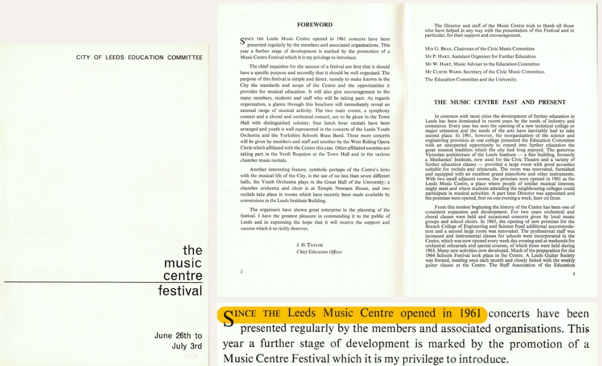
As you may recall, we believed the conservatoire had been founded in 1965. For a moment, it really felt as though the 60th anniversary celebrations had been completely derailed, and we’d missed the mark by four years. I now know that having multiple or contentious founding dates is a common thing for many institutions – more common for older institutions than ours, perhaps, but still not as totally disastrous and world-ending as we initially thought.
The more research we conducted, though, the more this confusion started to resolve itself. Prior to 1965, the Music Centre did not have a full-time director and was not delivering full-time courses. Mark went so far as to dig through old reports at the West Yorkshire Archive Services and found what he declared ‘OUR ORIGIN STORY!!!’ in the Leeds Education Committee report on the Branch College of Engineering and Science from 1961-62: ‘Although one would not normally connect music with engineering, this is the appropriate point at which to note the establishment of a Music Centre for Leeds. This Centre has been accommodated, after necessary repairs and redecoration, in part of the top storey of the College, and is a place where performers, instrumental and choral, may come together to play and to improve their standards’.
Crisis averted!
When it was time to actually decide what to include in the exhibition, it was quite tricky. To give you an idea of a couple of things I really loved and wanted to display:
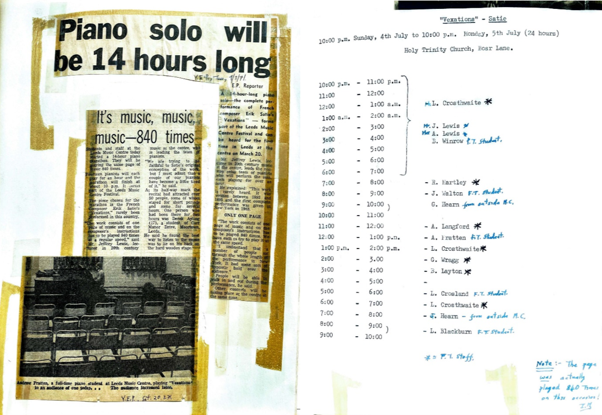
These stories from the early 1970s about two separate performances of Erik Satie’s Vexations. For anyone who isn’t aware, there is an inscription at the beginning of this piece that reads: ‘In order to play the motif 840 times in succession, it would be advisable to prepare oneself beforehand, and in the deepest silence, by serious immobilities’. There are no known public performances of Vexations prior to the 1960s, at which point the idea took hold that the piece needed to be performed 840 times (even though this was not necessarily Satie’s intention!).
The first known performance was organised by John Cage and took place in Manhattan in 1963; Leeds Music Centre was a little late on the trend, in that our first attempt didn’t take place until 1971.
Not only did I simply find this story particularly lovely and of its time, but I also really appreciated the way it had been laid out in the scrapbook: there were newspaper articles, a list of students and staff members who had taken part and the time slot in which they had performed, and there was even an annotation from Ian Milnes himself declaring ‘The page was actually played 840 times on this occasion’, which suggests that they didn’t quite pull it off the first time!
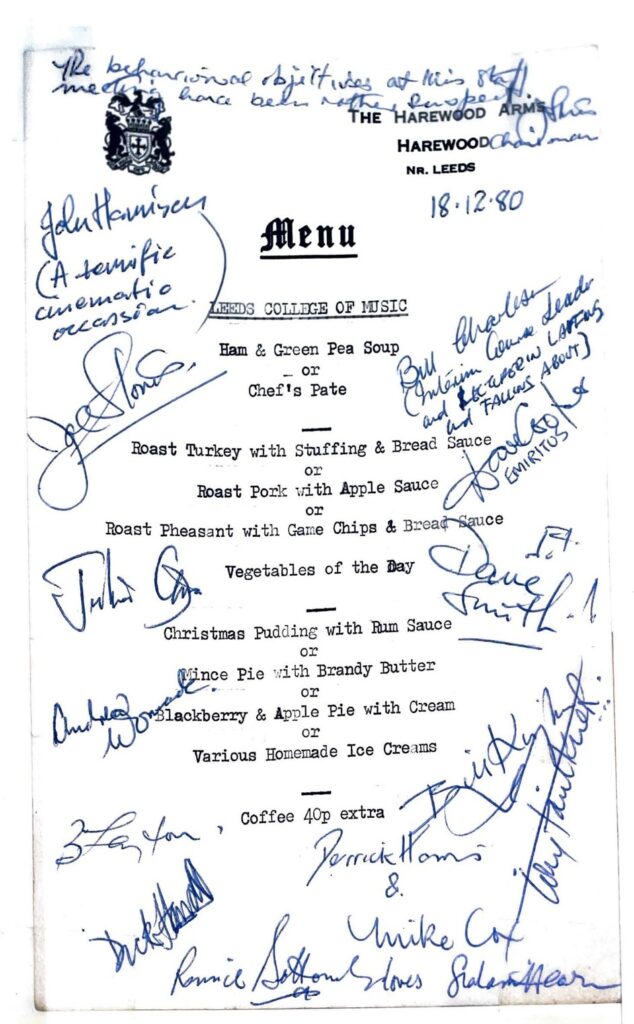
Another favourite of mine was this signed dinner menu from a staff meeting in the 1980s. I was very excited by this for reasons that I can’t quite explain. There was something about the process of going through our archives for months on end that made me feel as though I really knew these people, despite not knowing them at all! These were big names in the founding of the college, names that had been cropping up since volume one of the scrapbook, but what I really loved was how ‘human’ it seemed. They hadn’t signed it because it was an important document; they’d signed it at the pub, potentially drunk, clearly having a good time.
But ultimately, I had to come to terms with the fact that neither of these items would display particularly well, primarily because they both required lengthy explanations much like the ones I’ve just given. There was also the scrapbook problem – no matter how many interesting things we found in the scrapbooks, it wasn’t really going to be possible to display more than one double page spread.
In the end, we focused on things that were eye-catching, things that told a story without needing to be over-explained, and things that would physically fit. We also incorporated items that had been donated or used elsewhere in the conservatoire: a guitar made by students on our Music Instrument Technology course in the 1980s, still available for current students to borrow; a Mac computer used in the early days of our Music Production course; and a flugelhorn originally belonging to City of Leeds College of Music that was finally returned in 2024!
We did also decide to display one scrapbook: volume 5 from the 1980s, open on a double spread featuring newspaper cuttings about Caroline Boaden, a current staff member, and her successful endeavours while she was a student here.
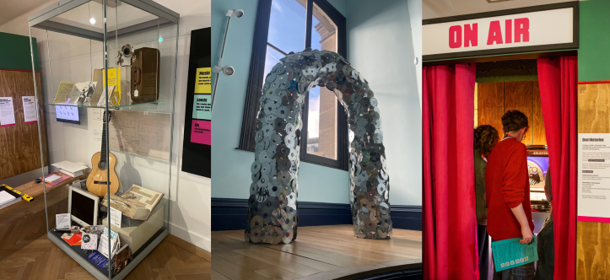
The CD arch was commissioned by us and created by students at Leeds Arts University (for any other music libraries trying to downsize their CD collection – try this!). The jukebox was made by Sound Leisure, who are based in Leeds and are actually the oldest single-ownership jukebox company in the world. As part of the 60th anniversary celebrations, our alumni co-ordinator Elysha recorded a series of oral histories with staff and students, past and present. These were then pressed to vinyl and can be listened to on the jukebox as part of the exhibition.
The 60th anniversary is still ongoing and the archive has been heavily involved. The involvement has been so heavy, in fact, that I am slightly concerned for the materials themselves, as they’re being consulted quite frequently having not been looked at for years, if not decades. Preservation is something we’re working on, especially as the conservatoire has received National Lottery Heritage Funding for this project. While a large portion of this is going towards events and outreach, some is set aside for storage and preservation. We’re currently in the process of acquiring new boxes and folders, including bespoke boxes for the scrapbooks. We are also investigating the possibility of outsourcing the digitisation of the scrapbooks, prioritising the earliest and most fragile volumes initially.
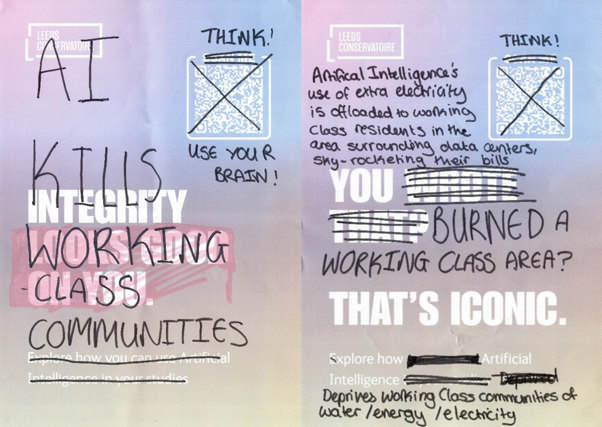
We do keep adding to our institutional archive. Heather and I are working on a long-term strategy based on sector-specific best practice and the library resources currently available to us. In the short-term, we’re making sure we have access to ongoing promotional programming materials, the majority of which are digital now. We’re also taking a leaf out of Ian Milnes’ book and adding any physical items that we think ‘tell a story’, so to speak. One such example is these AI usage guidance posters, which were protested and defaced by students and subsequently re-designed to encourage accountability.
While things are still slightly up in the air (and perhaps they always will be to a certain extent, as an institutional archive isn’t exactly a task you can ‘finish’ per se), it is starting to feel like: 1. We know what we have; 2. We know what to do with it; and 3. We understand how important it is.
We’re currently in the process of adding to our AToM catalogue. You may be interested in viewing our Special Collections there, which are being imported as we speak; eventually, our institutional archive will be available to view as well. You can also view the Cats of Leeds Conservatoire Library collection, which was initially a series of test records created by Library Manager Jane Henshaw, but I would argue, should remain a part of our catalogue even once we’ve become seasoned AToM users. View our AToM catalogue here.
Laura Johnson, Assistant Librarian, Leeds Conservatoire
Works Cited
Dray, Judith and Garrigan, Mandie, ‘Special collections in vocational performing arts education’, paper presented at the IAML (UK & Irl) Annual Study Weekend in Cardiff (26/04/2026).
Woodall, Alexandra, ‘Rummaging as a strategy for creative thinking and imaginative engagement in Higher Education’ in Engaging the Senses: Object-Based Learning in Higher Education, eds. Helen J. Chatterjee and Leonie Hannan (Surrey: Ashgate, 2015), pp. 133-155.
Thank you Judith for such a detailed and engaging article about the archival challenges involved. Good to see also that an ASW presentation proved so useful to you. Oh, and definitely retain the cats collection.