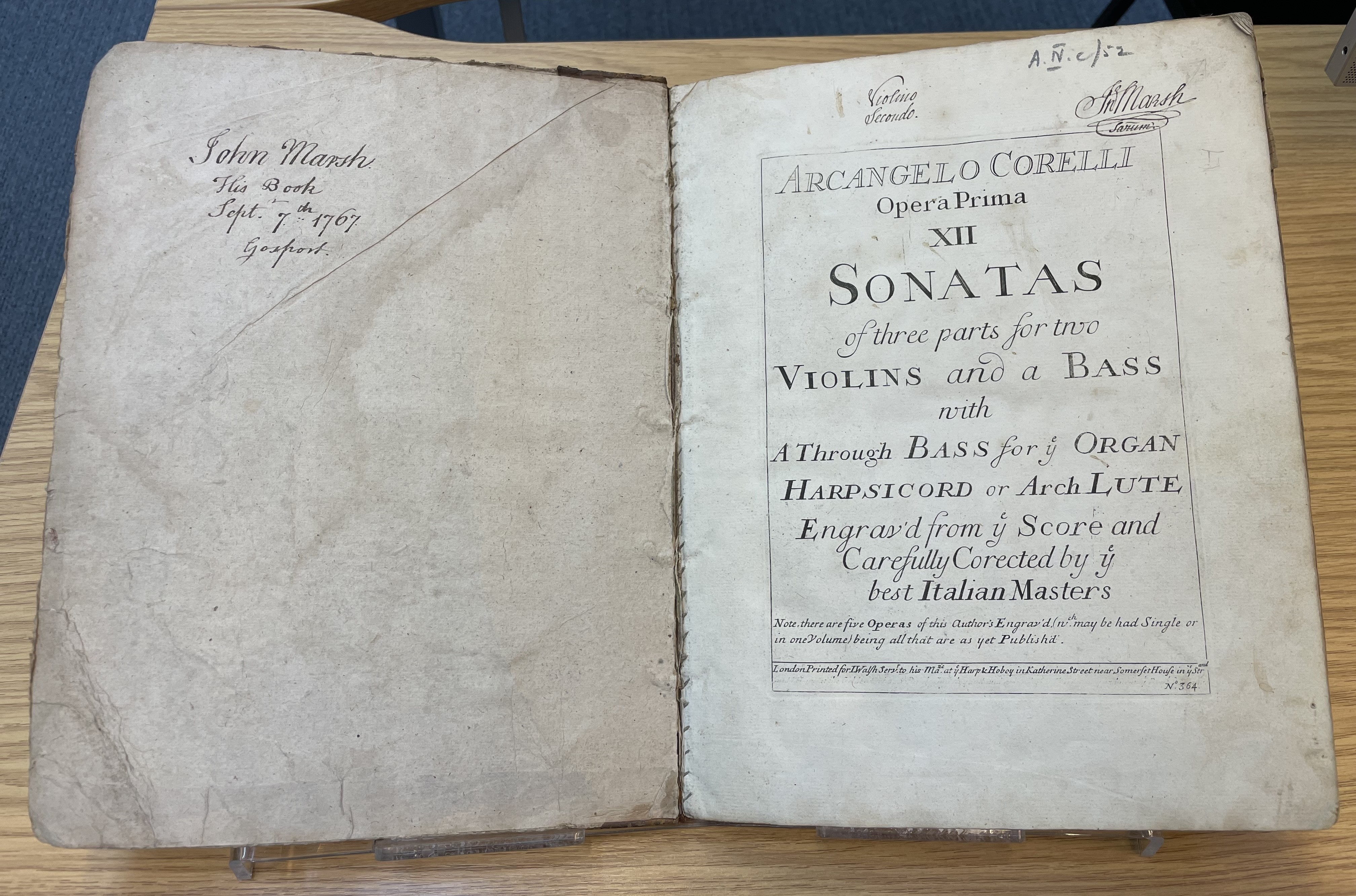
When it comes to early printed music in special collections, the musical content or bibliographical details of a publication often tell only half the story. The other half is told by the unique characteristics of the specific exemplar at hand: its binding, for example, or ownership history and inscriptions. These can help to place an item in its historical context, and for this reason many libraries will often keep multiple reference copies of the same publication. The printed pages may hold the same information; but if one looks beyond these, each copy tells a different story.
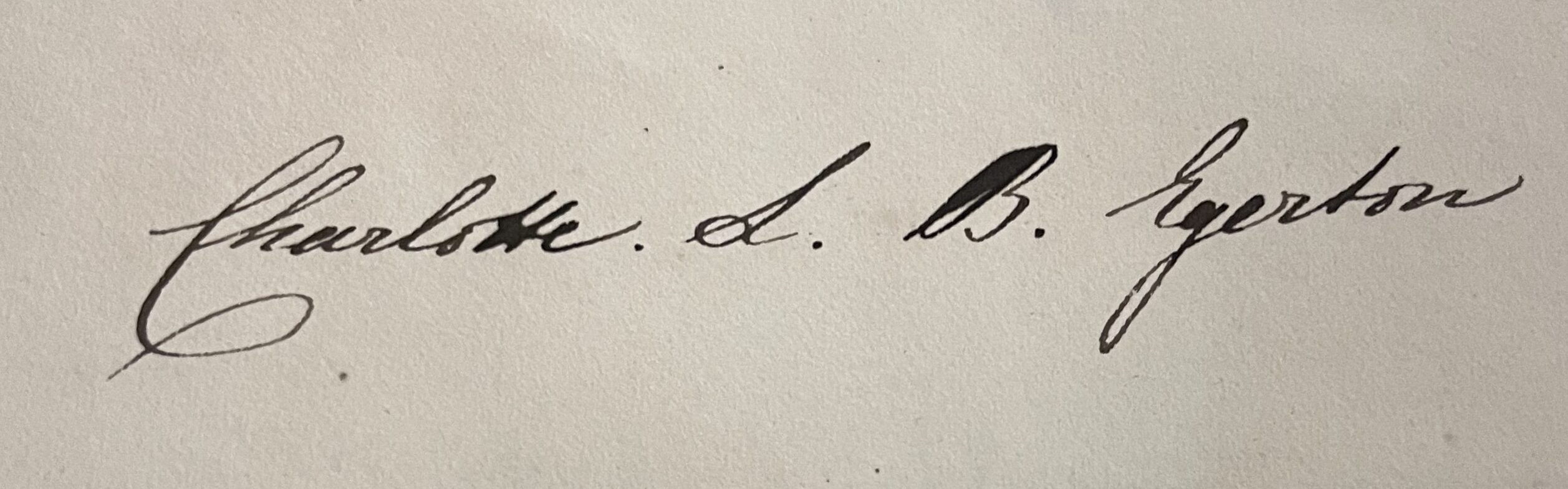
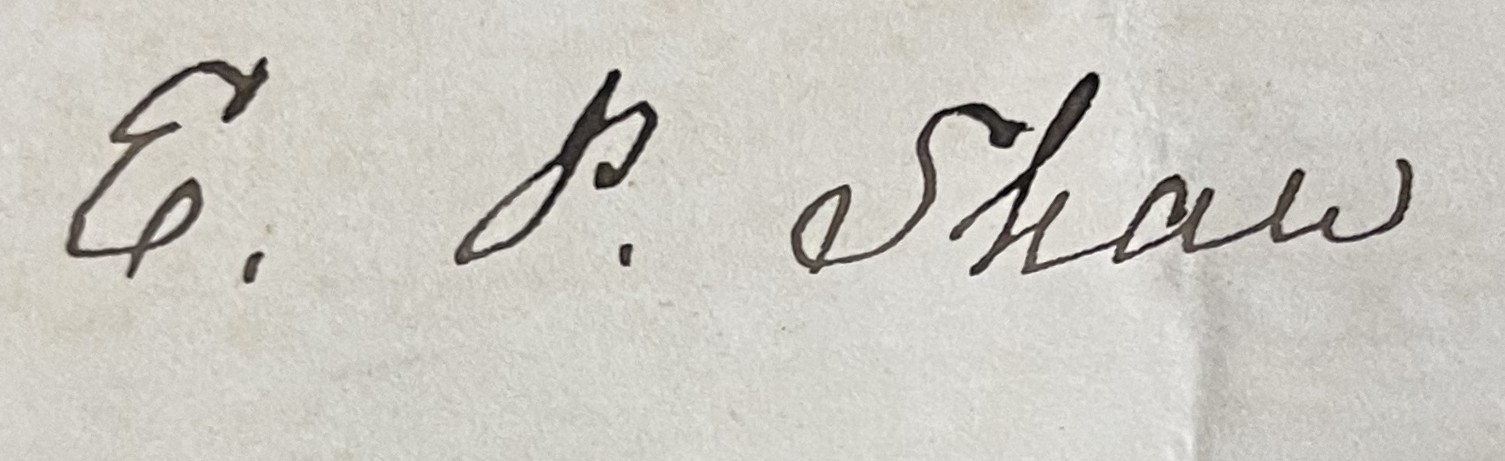
The thrill of identifying a real-life historical figure from an inscribed name on a piece of long-forgotten music is one that will never grow old for me. In many cases, this is surprisingly straightforward. “Charlotte L. B. Egerton”, for example, who wrote her name inside the Royal College of Music’s printed music volume D2736, was fairly easily identified as Charlotte Lucy Beatrix Egerton (1824-1845) of Tatton Park, Cheshire. She already appears on IAML (UK & Irl)’s Cecilia database (https://www.cecilia-uk.org/html/search/verb/GetRecord/1890/), where other parts of her music collection are described, still in situ at her family home. “E. P. Shaw”, whose name appears on an RCM copy of William Henry Havergal’s Evening Service, Op. 35 (E313) required a little more digging, but with the help of WikiTree she was soon confirmed as Ellen Prestage Shaw (1823-1886), the composer’s third daughter.
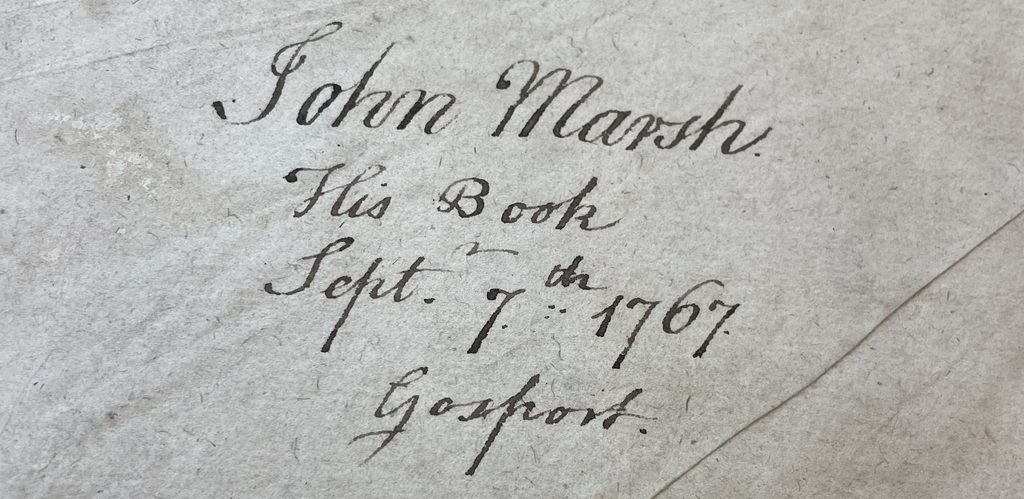
John Marsh, whose name was found last week in the RCM Library on an unaccessioned bound set of Corelli’s Trio Sonatas, Opp. 1-4, was in fact even easier to identify than these preceding examples. The gentleman composer and organist John Marsh (1752-1828) is well known to students of music history, mostly owing to the remarkable survival of his 37 volumes of diaries (more on these later). The inscriptions on what is now RCM D3814 leave no doubt that he has been correctly identified: “John Marsh / His Book / Septr. 7th. 1767. / Gosport” corresponds with his sojourns in Gosport between 1764 and 1768, while the later inscription, “Jno. Marsh / Sarum” speaks to his period of residence in Salisbury between 1776 and 1783.
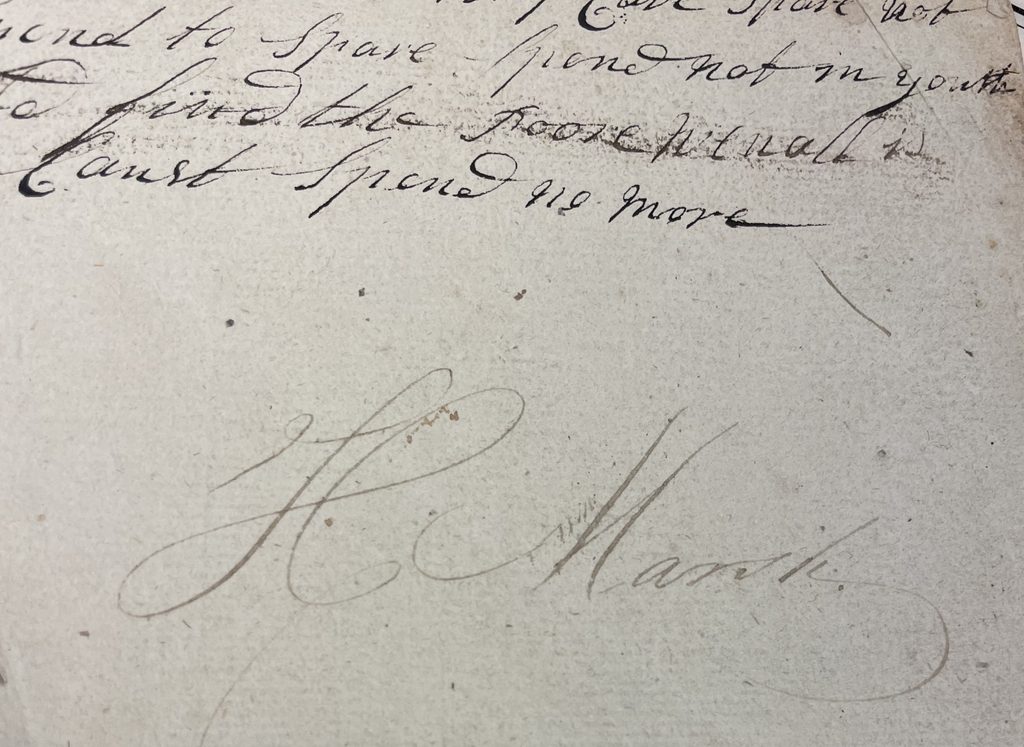
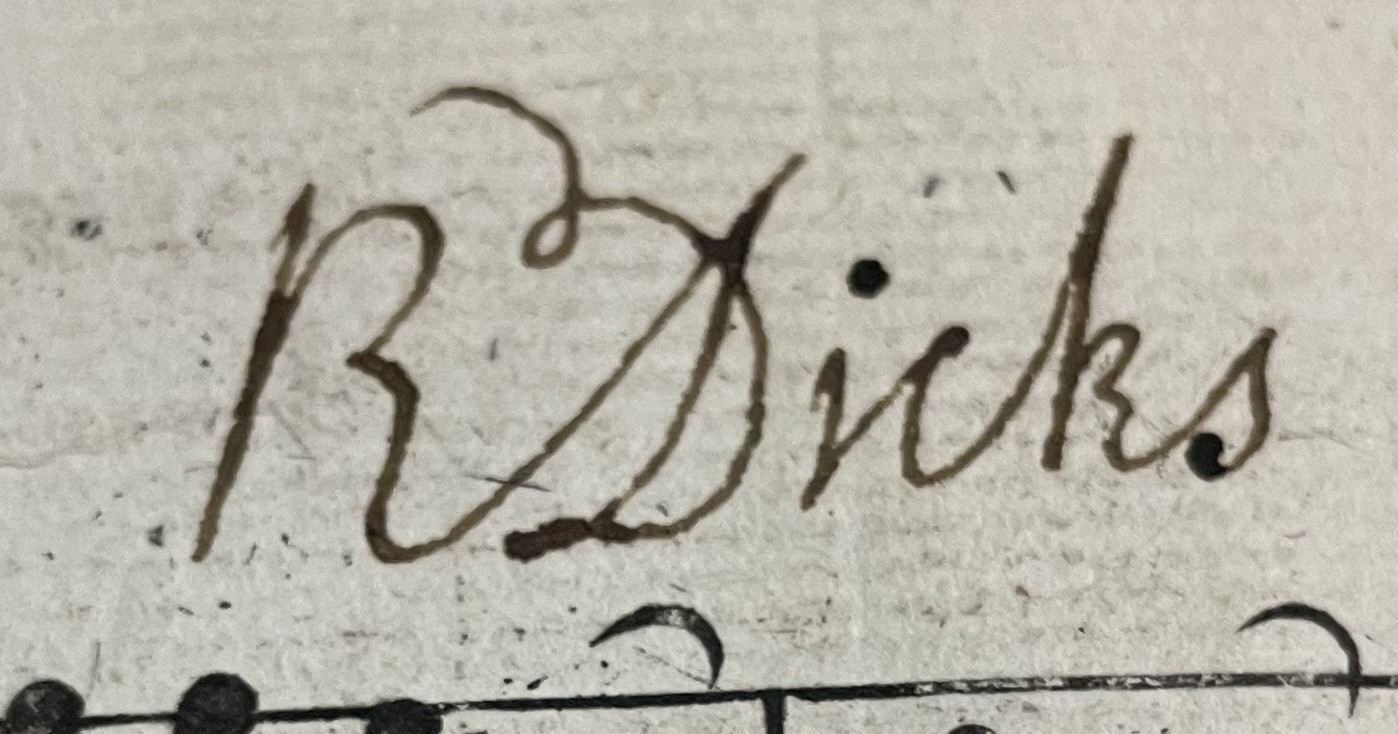
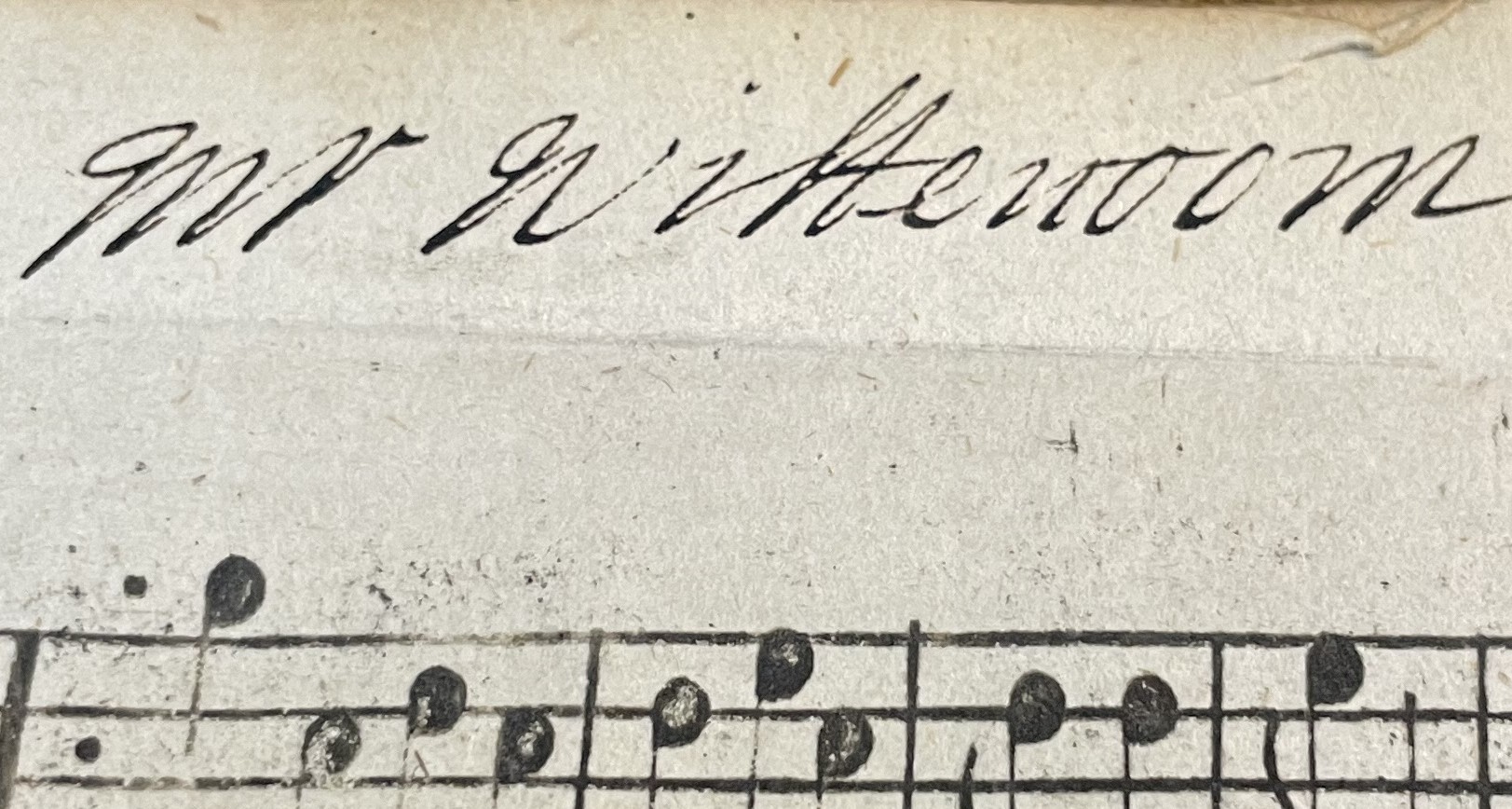
It is not, admittedly, very unusual to come across music formerly owned by performers (professional or otherwise). The RCM can boast many such examples, from the cellist Joseph Ries (1791-1882) to the pianist Edward Dannreuther (1844-1905). Marsh’s copies of Corelli caught my eye, however, not only for being fairly heavily annotated – always a potentially interesting glimpse into contemporaneous performance practice – but also for Marsh’s comparatively detailed ownership inscriptions, together with the presence of three other names spread throughout the surviving parts: “Rd. Dicks”, “Mr Wittenoom” and “H. Marsh”. With Marsh’s diaries offering valuable insight into his life and networks, could these other men be identified? And could these parts even be tied to a specific historical performance?
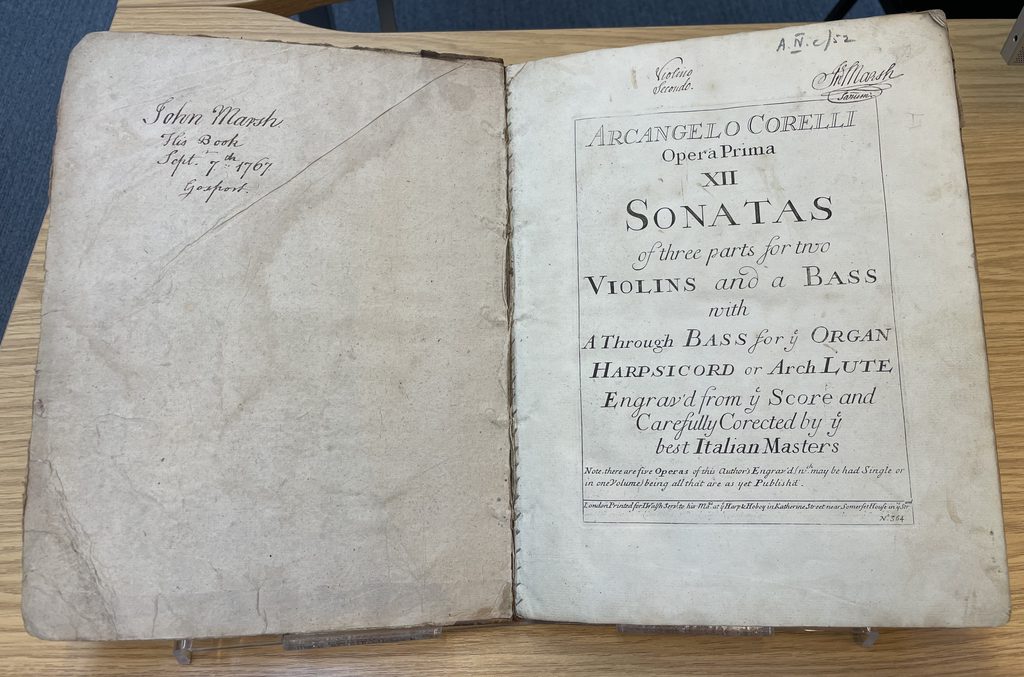
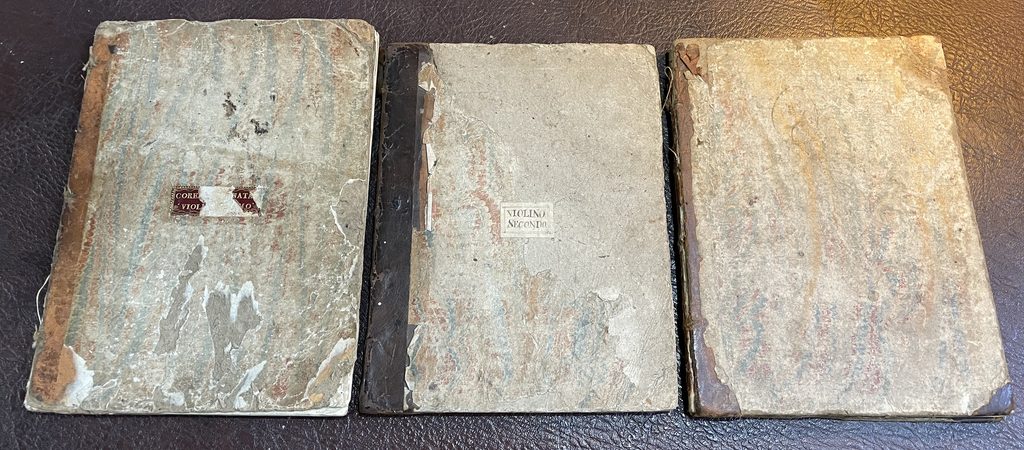
First, however, it is useful to describe the items at hand. The four publications represented in these volumes – Corelli’s Opp. 1 through 4 respectively – could originally be purchased separately, although it would appear from the many surviving sets that a more common approach was to purchase all four works together and have them bound together in part books. One volume would contain all the Violino primo parts, the next all the Violino secondo parts, and so forth.
Marsh’s set of Corelli is sadly incomplete, wanting both its Violino primo and Organo volumes. When first discovered last week, a corresponding Violino primo volume sat alongside Marsh’s, and was apparently at one time considered part of this set. But despite some visual similarities, a close examination of this volume reveals a different (albeit unknown) provenance. There are no ownership inscriptions, the pages are trimmed to a different height, and – most tellingly – comparison with Marsh’s parts reveals that the music was re-engraved between the two printings. Although the title pages are identical, this Violino primo volume in fact belongs to a different edition.
As a result of Corelli’s popularity, his works were reprinted dozens of times, and even when only one publisher is considered – in this case, John Walsh – it is notoriously difficult to identify the edition or printing at hand. William C. Smith and Charles Humphries, in their two-volume Bibliography of the Musical Works Published by the Firm of John Walsh, identify at least six Walsh variants of the Op. 1 sonatas alone, all with subtle changes in title, imprint, music engraving, or which portrait of Corelli is included. In reality, the situation is even more complicated, and several variants exist in the RCM Library that do not correspond to any described by Smith and Humphries.
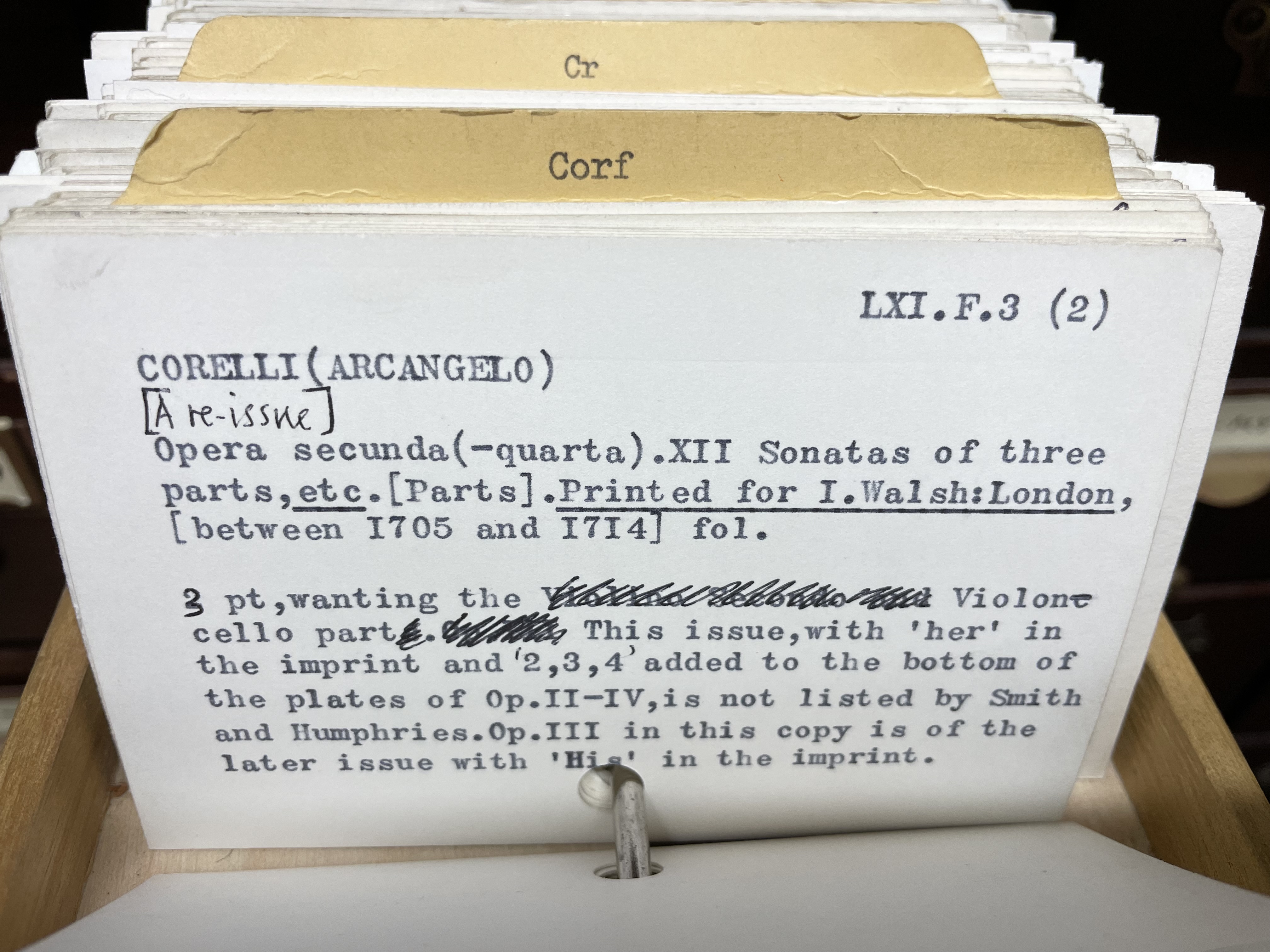
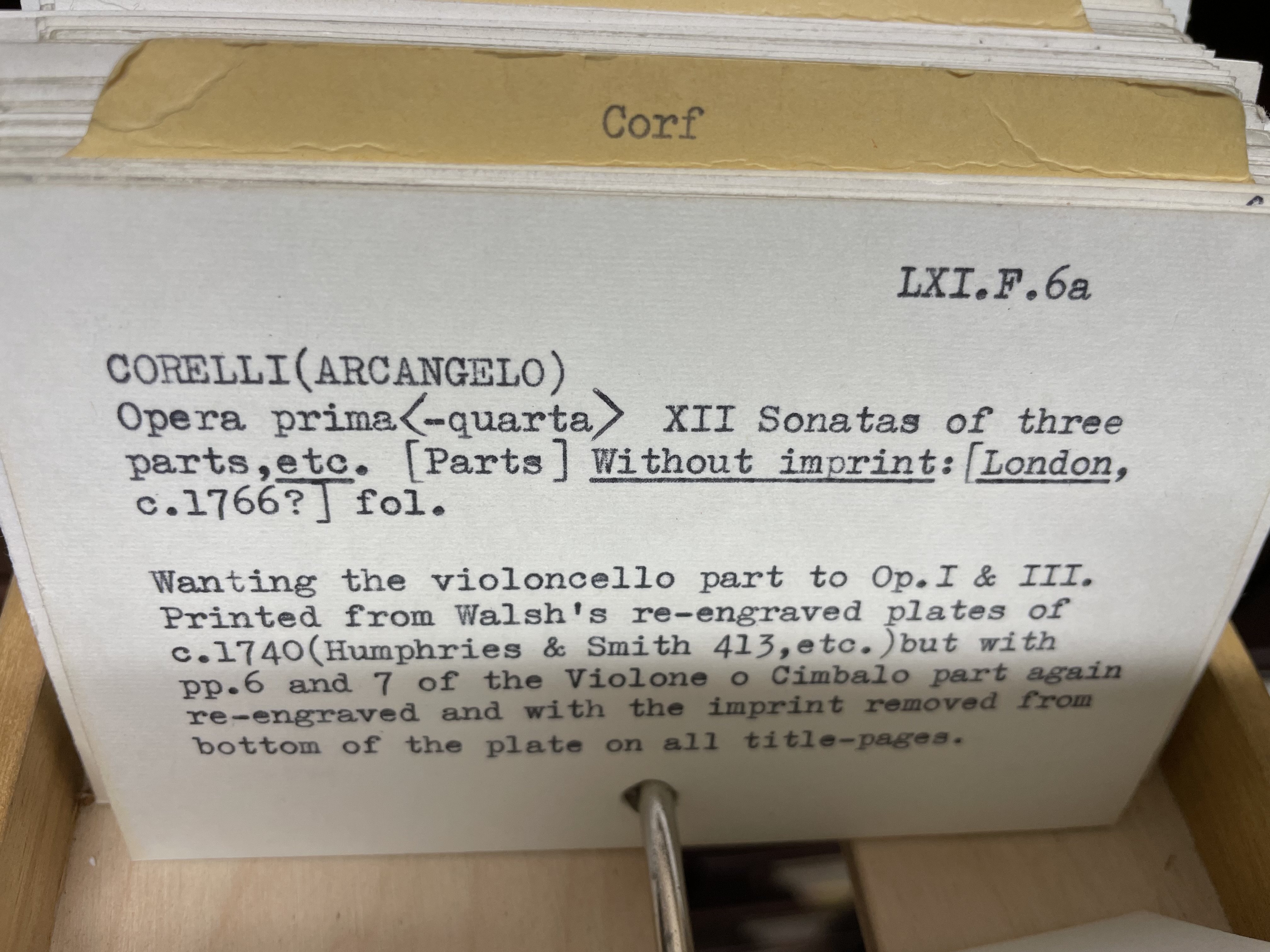
Matters are further obfuscated in Marsh’s set by the lack of Violino primo parts, meaning that the all-important portrait of Corelli – which could provide a clue as to the edition – is missing. Nevertheless, Marsh’s set has tentatively been identified as a late edition from circa 1760 (no. 414 in Smith and Humphries), taking into account the evident re-engraving of music compared to earlier RCM copies. Marsh’s inscribed acquisition date of 1767 is also a relevant detail. While this alone is by no means a trustworthy guide for establishing date of publication, it is at least somewhat more likely that shops at the time were selling editions printed around 1760 than those issued twenty years previously.
One striking thing about Marsh’s inscribed date of acquisition is that it shows that he was only 15 years old when he bought this music. This juvenile character is reinforced by the fact that Marsh’s brother, Henry (1753-1821) – then a 14-year-old scholar at Bishops Waltham School – evidently used the Violoncello part as rough paper for handwriting practice at some point in its history. He is the aforementioned “H. Marsh” whose name appears in the parts, but seems unlikely to have had any other (that is, musical) connection to these Corelli sonatas: as Marsh wrote in his diaries, his brothers were not “much interested in [music], as they generally sought some other amusement” (Brian Robins, ed., The John Marsh Journals (1998), 29).
But what of “Rd. Dicks” and “Mr Wittenoom”, whose names are inscribed at the top of the Violino secondo volume and part-way through the Violoncello volume respectively? They seem promising as candidates for onetime performers of this music, but, sadly, Marsh’s diaries are silent on these gentlemen. Wittenoom – a rather distinctive name in eighteenth-century England – does not appear at all, while the “Mr Dicks” mentioned on page 375 of Brian Robins’ edition seems an unlikely match; this Dicks was the Archbishop of Canterbury’s Secretary in 1786. Perhaps these men belong to a later period of these volumes’ history, after they left Marsh’s possession. It is rather intriguing to note that, according to Ian Abbott, the Rev. John Burdett Wittenoom (1788-1855), chaplain to the Australian Swan River Colony, brought a cello with him to Australia upon his emigration in 1830. Could he, or a relation, be Marsh’s “Mr Wittenoom”? Further enquiry along these lines might possibly be rewarded.
Yet Marsh’s diaries do not completely fail us when it comes to identifying performers of these sonatas. On the contrary, they offer strikingly clear insight into how these very parts were used. Only a month after he bought them on 7 September 1767, Marsh is found practising these works in his regular music lessons with his teacher, the organist Mr. Wafer. Such was the value of this ordered regiment of study, Marsh credited these very sonatas with giving him the ability to play at sight:
… on October the 12th. [1767] began [Corelli’s] sonatas of which I pick’d out a new one against every time Mr Wafer came. By this means I went thro’ the whole 48. in less than half a year & soon learnt to read music so as to play (what was within compass of my execution) at sight, which indeed I did as soon as I came to the 6th Sonata, which I so played to Mr. Wafer, happening not to have had the time to look at before he came to attend me.
(Robins, ed., The John Marsh Journals, 45)
Only three months later, the parts were used by a full ensemble for the first time:
… on Friday the 29th [January 1768] went with Mr Wafer for the first time to Mr Phillips’s little weekly concerts at Weovill, where there happening that evening to be no one else present we play’d only Corelli’s sonatas, of which I took the 1st. fiddle, & old Mr Phillips the 2d. & Miss P. the thorough bass on the spinnet accompanied by Mr Wafer on the tenor. As I had never heard these sonatas compleat before, I was much pleas’d by the wonderful improvement occasion’d by the addition of the bass …
(Robins, ed., The John Marsh Journals, 47)
As Lidia Aurora Chang explains, these “concerts” were in fact private musical parties, which took place in homes (in this case, the home of Mr. Phillips). Such a setting befits Corelli’s music more than public performance. It is interesting to observe Mr. Wafer’s playing of the cello part on a viola: a noteworthy display of adaptability and musicianship, even in days when a more flexible approach to instrumentation was customary.
Three months after Phillips’ concert, Marsh had outgrown Corelli’s Opp. 1-4. As he wrote:
On the 30th. of March, in less than 6 months since I began them, I finish’d going thro’ the whole 48. sonatas of Corelli, after w’ch I went on with some more of his solos (not omitting some of the double stop ones) & began learning some difficult solos of Festing’s in a more modern style
(Robins, ed., The John Marsh Journals, 50)
So ends Marsh’s known use of these volumes, although they at least accompanied him on his later travels as far as Salisbury (“Sarum”) in the late 1770s or early 1780s. After that, who can say? Perhaps on to Australia with the Rev. Mr. Wittenoom? The story remains unclear, as indeed is the tale of how they came to RCM Library. But by the remarkable survival of Marsh’s diaries, we can at least say that the parts now present in the RCM Library were fundamental to his early musical development.
It takes only the slightest clue – a name, a date, or a place – for a story to unfold. As shown by the case of Marsh’s Corelli sonatas, the study of an object’s material history can often be just as enlightening as its contents. Many special collections hold hundreds of items waiting to be examined in this way. Each could have a story worth telling.
Jonathan Frank, Assistant Librarian, Royal College of Music
Bibliography
Abbott, Ian. ‘A History of the Cello in WA – Part 1.’ The Metropolitan Symphony Orchestra. Accessed 13 October 2026, https://www.metsoperth.org/mf-articles/2019/hist-cello-wa-p1.
Chang, Lidia Aurora. ‘“Leisure with Decorum”: Gentlemen Making Music in the Georgian Era.’ PhD thesis, The City University of New York, 2021.
Robins, Brian, ed. The John Marsh Journals: The Life and Times of a Gentleman Composer (1752-1828). Stuyvesant: Pendragon Press, 1998.
Smith, William C. A Bibliography of the Musical Works Published by John Walsh During the Years 1695-1720. [London]: The Bibliographical Society, 1968.
Smith, William C. and Charles Humphries. A Bibliography of the Musical Works Published by the Firm of John Walsh During the Years 1721-1766. London: The Bibliographical Society, 1968.