Today on the IAML (UK & Irl) blog: Simon Crosby Buttle introduces a project to document the lives, works and activities of a truly fascinating nineteenth-century musical family with a famous – if unexpected – name. Simon writes:
J. R. R. Tolkien (1892-1973) is a name ingrained in modern fiction and fantasy, a legendary author and poet who was also a philologist and Professor. These days he is most commonly known as the mind behind the creation of a fictional secondary world known as Middle-earth, in which he set The Hobbit, The Lord of the Rings, and The Silmarillion. His life, works and family history are catalogued in many other places, but it is less commonly known that he was also from musical stock. As he wrote to William Galbraith in 1956, “I come of a musical family. I am musically defective – I listen to it with delight and am tonally sensitive; but without technical knowledge. I bitterly regret that I cannot invent a tune; but naturally tunes or garbled versions of them run in my mind.”
For many years, our team at Volante Opera Productions (a small recording and performing company based in South Wales) have been working on recording and publishing the J. R. R. Tolkien-based compositions of the English-born Welsh composer Paul Corfield Godfrey (1950-present). Myself and others, having a passion for “lost” and “neglected” musical works, wanted a place to highlight these works, and our “Heritage” series was launched within our small company. The first release in this series was a recording of The Complete Songs of A. A. Milne (and Lewis Carroll) by Harold Fraser-Simson (2023). These projects by their nature can take a few years to come to fruition, as a large amount of research is required to find the music, and even more if the creation of new performing editions are required. We are currently working on various collections, with projects at varying levels of readiness (Victor Hely-Hutchinson, David Vaughan Thomas, Maude Valérie White & R. S. Hughes to name but a few). Little did we know that the two branches of our recording projects would find a convergence point: the name of Tolkien.
Tolkien’s quote to Galbraith was already known to me, but it was such a throwaway line that is far too easily overlooked, along with other quotes in Tolkien family histories that refer to a Music Publisher and “failed composers”. I also knew that there were pianos existing bearing the name “Tolkien”. It was only when a member of our community sent me a link to a score for an opera by a Frederick Tolkien that I realised there may be a bit more to it.
I started research on my own, looking through library listings to find any more sheet music by this “Frederick”, but found that there were a lot more musical Tolkiens: composers, lyricists and publishers. The growing research suggested that this “musical family” was much larger than a throwaway comment might suggest.
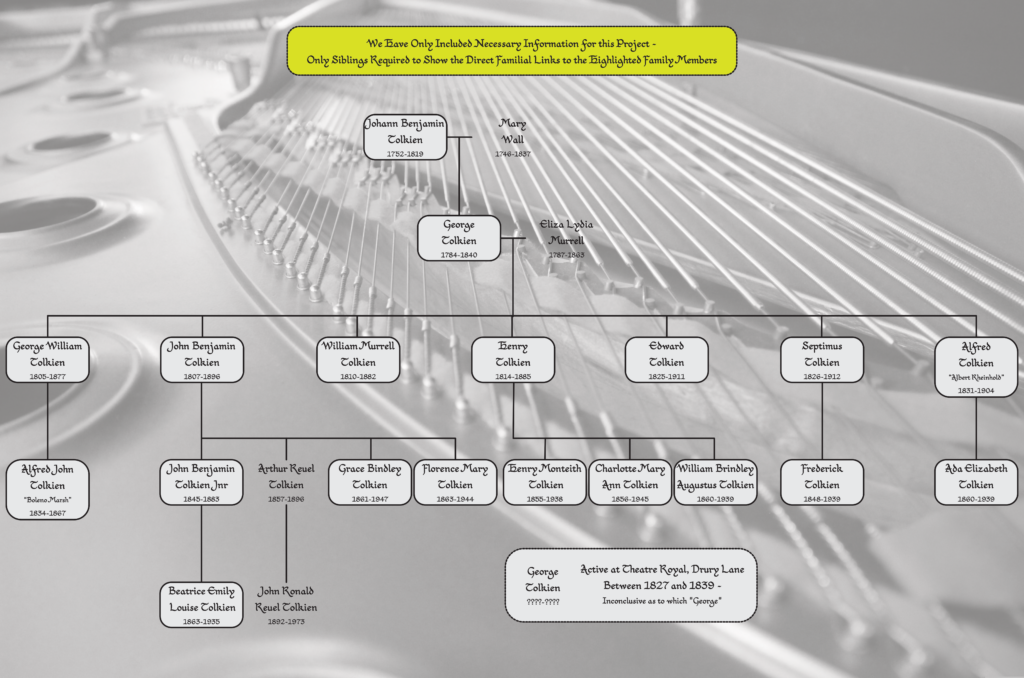
After my initial research I corralled a friend, Emma Mary Jones, to come on a research trip with me to the British Library to look at some of the music in person and, due to being out of copyright, scan anything we could find. There was far too much for one trip, so I chose a few samples from each listed composer or lyricist (George W. Tolkien, William Murrell Tolkien, Henry Tolkien, Edward Tolkien, Alfred Tolkien and Frederick Tolkien) to begin with. What we were presented with was a very interesting collection of sheet music, often beautifully presented with full colour artwork on the covers, covering both songs and piano music for dances.
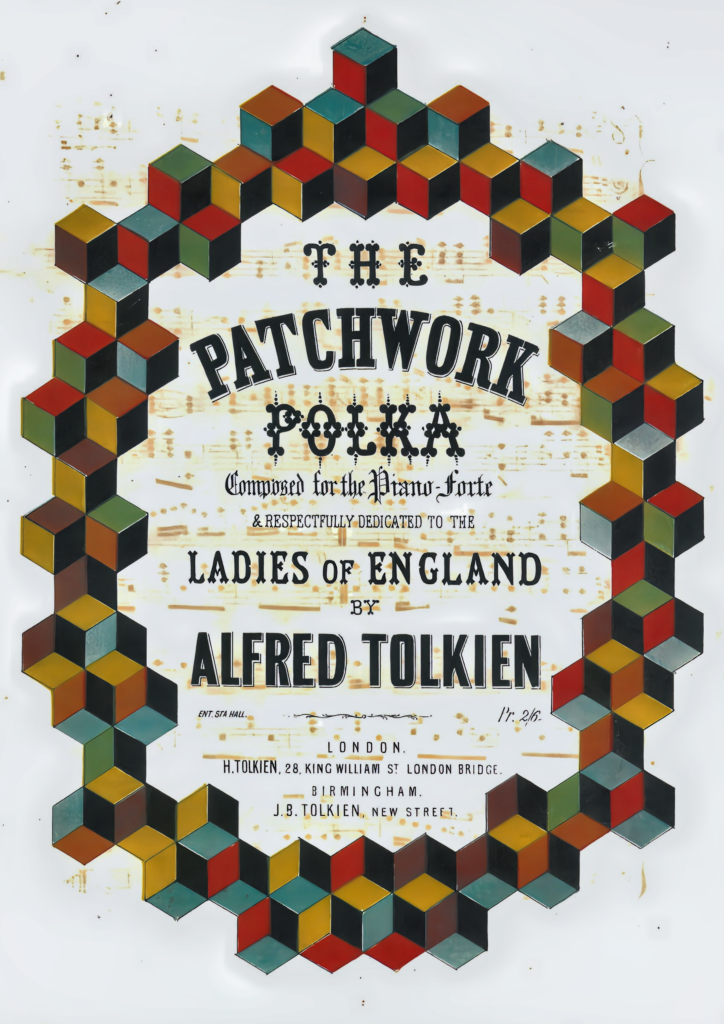
This first batch was investigated thoroughly and what was found was music very much of its time: Victorian/Edwardian pieces for in the home and concert halls before the advent of recorded music. This was the “pop” music of its day (for want of a better way of phrasing it), from an era where the new songs were bought as sheet music, taken into the home and performed by the family as entertainment. That is not to say they were simple – far from it in some cases – but suited to the tastes of the day. There were some absolute gems in there that wouldn’t leave my head and at that point I decided – we needed to explore this much more fully and delve further into this musical family as there was a lot more to be found.
Whilst awaiting our next trip to the BL I co-opted a couple of friends who have helped immensely with our other Tolkien-based albums: Phil Walch and Steven Jones. Phil Walch is part of the team at Tolkien Guide. As part of the team there he continues work to better detail Tolkien’s letters and is currently building a unified bibliography of Tolkien’s published works. Steven Jones, a fellow Tolkien fan and prominent collector in the community, has a passion for all things Tolkien and being interested in all aspects of music is ideally placed to help with our research. With their help, we began hunting through archives, conflicting family trees and newspaper articles to try to clear up some of the “murky waters” from the various researchers who have delved this far into the past members of the Tolkien family.
Instantly apparent was that all of the named Tolkiens we were finding to that point, except Frederick, were brothers. The family business of that generation was definitely music – the early research quickly found that the other brothers of that generation ran piano manufacturers, piano tuners and music shops throughout London and Birmingham. The casting of a wider net showed this passed onto future generations, where more names were appearing as performers too.
After much emailing around for scans and another trip to the BL we had “all” that we could find at that point of the music and I started up a website for us to record our research. Trying our utmost to not jump to conclusions (as other researchers occasionally have when researching this generation – all of which did not delve specifically into the music, opting to focus on the names and their occupations) we have created a public receptacle for our current research that people can read and contribute to, and correct should they have more details.
The picture it paints of this generation (and the subsequent) of the Tolkien family is one of an influential part of the popular music industry at that time. Tolkien pianos went worldwide, they published music, composed music, wrote lyrics, ran music-lending libraries and sold tickets to large events. All of this centred around the multiple piano shops in London and Birmingham. They were very much a musical family, and in a place of some prestige.
With so many dates and similar names, we needed to get our house in order. So I started an “advanced catalogue” of all of the music we could find with information from the covers, published dates, dedications etc. This started to throw up interesting anomalies. A prime example of this is Alfred Tolkien (then with dates 1831-1867 or 1904): the varying records showed him as a pianist, composer, conductor, music teacher and… clown. There was a plethora of published music from after the date of his supposed death in 1867, so that must have been in error but where had it come from? An Alfred Tolkien was listed as a clown by the name of Boleno Marsh who tragically died after an accident on stage in 1867 so they couldn’t be the same person. The name “Tolkien” at that point in the UK was only from a couple of branches of the same family tree so it must have been a relative with the same name. Eventually we managed to separate out the two. Alfred Tolkien (1831-1904) was a pianist, composer, conductor, music teacher; and his nephew Alfred John Tolkien (1834-1867) was a professional clown. The unfortunate tradition of giving your children a relative’s name and poor record keeping of the times does complicate this task immensely. I’m sure some readers know this pain all too well.
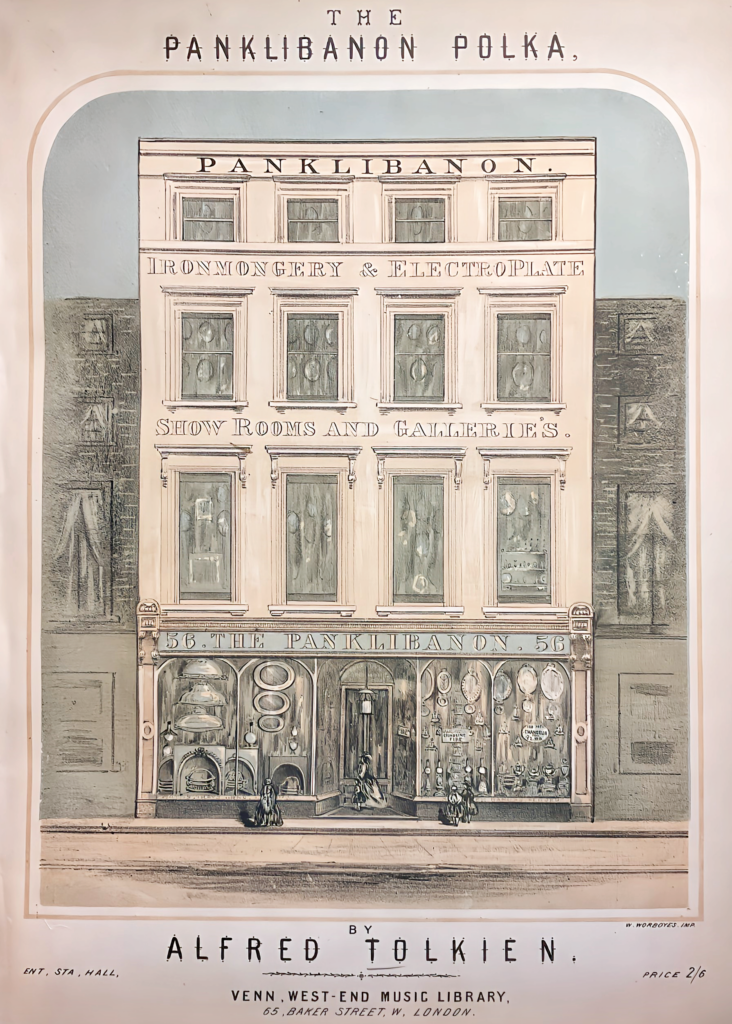
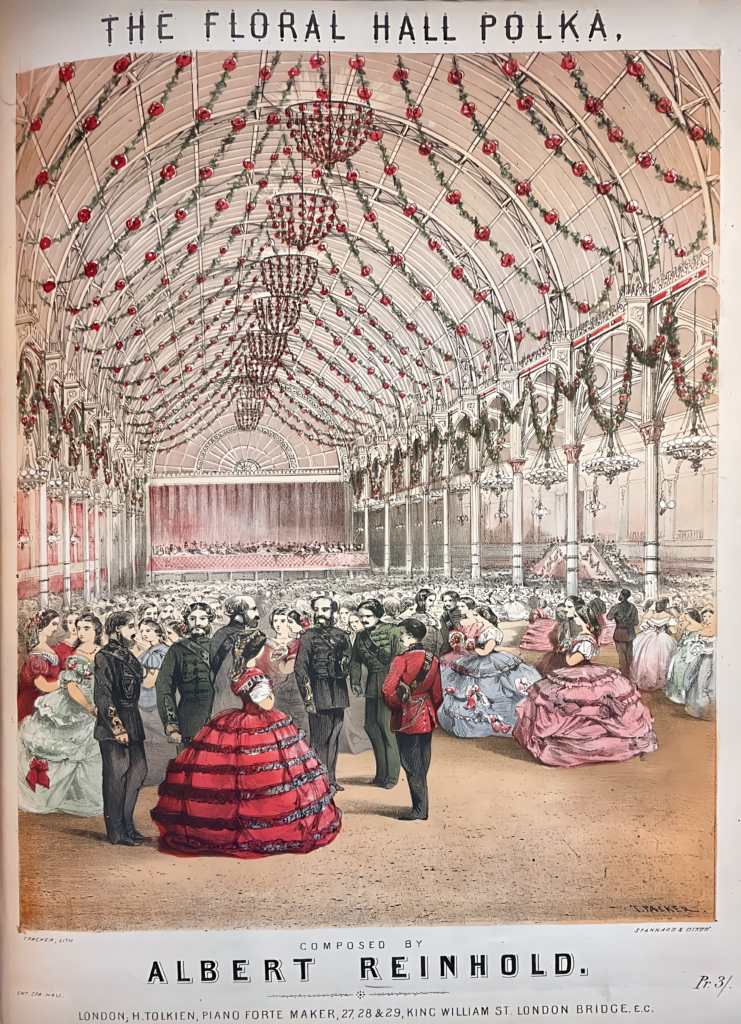
The music we gathered to date presented us with other startlingly (new) facts. Alfred Tolkien (1831-1904) had quite a few compositions which had the name “Albert Rheinhold” (often spelled in differing ways) in brackets beneath. This was setting off alarm bells… had he been using another name for a while? The short answer is… yes. Through research of the sheet music alone we discovered that for a period Alfred was “Albert”. The music has listings of “other compositions by” which go across the two names. We also can’t find any record of an Albert Rheinhold in the area at that time. The dreaded searching began again and we found a large number of compositions by “Albert” that we had obviously missed earlier so another research trip was in order (this time involving the Cambridge University Library and the BL). This brought to light more music but also proof of the name change. A piece of music by Alfred was reissued nearly a decade later under the different name, “Albert”. Discoveries like these using the sheet music had been overlooked by non-musical researchers previously.
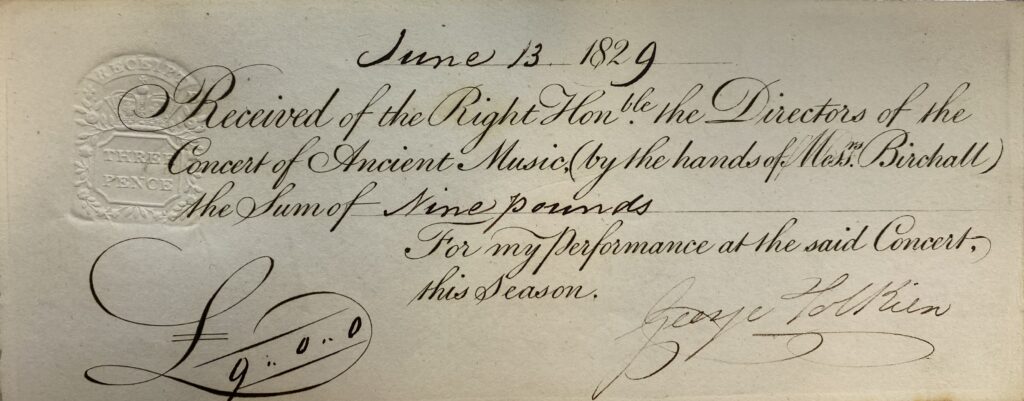
Other interesting mysteries also came to light – one member of the family we were researching was also a bass in the chorus of the Theatre Royal, Drury Lane between 1827 and 1839. The problem was that we could not definitively say which, as the hundreds of listings and playbills only list him as “Mr. Tolkien”. We found a receipt to him saying “George Tolkien”, with a signature, although this could be one of two Tolkiens according to the dates: a father or son. “George”, as in the father of the brothers we were looking at, seems to have spent most of his life as a watch-maker or auctioneer. His son George William was a musician who also went by “George” and so this remains an open and active part of our research.
Over a year on since our first research discoveries and music preparation for this new edition of the family’s works, other discoveries are made. We have found a functional Tolkien piano located at Winterbourne House in Birmingham that we will visit and photograph. We’ve welcomed another researcher, the incredible Chris Hara, who is currently scouring the entire British Newspaper Archive for more scraps of information, along with creating timelines of the family members and getting things ready to start creating maps of shop locations and dwellings to help clear up other mysteries.
Aside from pieces of music that we have not been able to source, our work is always a minor discovery away from opening up the remaining mysteries. Only recently Chris Hara discovered that John Benjamin Tolkien (piano and music shop owner in Birmingham) started out in partnership with the Chappell family, a name that is still known today for music publishing and selling. It seems that the Tolkien family of the 1800s was only a few steps away from still being widely known in music circles today. As the brothers died the businesses fell into administration and future generations moved on to other pursuits. For most of that century Tolkien was a household name associated with music, before being returned to the shadow before their non-musical descendant wrote a book and returned the name to the fore.
Though not yet ready, we will be recording some of the smaller scale works, possibly even all of them if we can bridge the gap of financing small projects without affecting our other projects and aims. The operas and cantatas by Frederick Tolkien (of which there are some incredible reviews of performances in the late 1890s to early 1900s) may be beyond our means currently but we have been retrieving the scores and supporting documents for them. A book may be a possibility with new editions of the printed music and family history connecting it. There has been quite a lot of music rediscovered but not so massive as to make this impossible (minus the operas). It will all depend on funding and interest, but in the meantime the large summary of our work, along with a cry for help from anyone who may be able to source the missing music, is updated frequently on our website: The Piano Makers | Volante.
Simon Crosby Buttle
Volante Opera Productions
Research by Simon Crosby Buttle, Phillip Walch, Steven Jones, Chris Hara & Emma Mary Jones.
Sources:
TCG – The J.R.R. Tolkien Companion and Guide – Reader’s Guide Part 2 (2017)
TCG – Guide to Tolkien’s Letters
Tolkien the opera composer | John Garth
All newspaper and publication sources from British Newspaper Archive and Archive.org
Thanks and Honorable Mentions:
Margaret Jones, Music Collections Supervisor, Cambridge University Library
Jeremy Edmonds, www.tolkienguide.com
John Rateliff www.sacnothscriptorium.com
Susan A. Snell BA, DAA, MA, RMARA, Archivist and Records Manager – Museum of Freemasonry, London
A very interesting article. I’m pleased to remind you that I’ve been researching the genealogy and history of the Tolkiens in England, and previously in Gdańsk and Prussia, since 2010. A few years ago, I blogged about George Tolkien, a bass singer in London, among other things. The same receipt as in this article is available on my blog.
https://tolkniety.blogspot.com/2022/11/tolkiens-great-grandfather-was-bass.html
Further to the comment by Ryazard Derdzinski I must apologize to him as I missed that the ancestry link directly above is to the Ancestry website and not his research blog. We should have included https://tolkniety.blogspot.com/ but also https://www.ancestry.de/family-tree/tree/115003210?cfpid=220142898351&dtid=100 (his Tolkien Family Tree on Ancestry) as points of reference in our sources above. That error of omission is mine.
Phil Walch
A further link of interest within the blog is https://tolkniety.blogspot.com/search/label/Tolkien%20Ancestry
Ryszard Derdzinski has been researching Tolkien’s family and their genealogy since 2010 and has been nominated by the Tolkien Society in their awards for his work.
Thank you, Phil, for this information 👍
I recommend the genealogical research carried out by Mr Deredziński, the Polish translator of J.R.R. Tolkien’s works.